
Thursday, December 13, 2007
Kim
Here we have some classic footage of Hanshi, Richard Kim, GMstr Urban’s first teacher. He is seen here lecturing on etiquette and a very interesting perspective on the circular concept of Ju. What makes this footage even more interesting to me, is that you can see GMstr. Urban sitting at a table behind Hanshi, Kim. This video was filmed at a Super Seminar that the two of them did, years ago in Canada.

Oyama
Here we have Sosai, Masutatsu Oyama. I personally find this short video to be of interest, as I never saw it before, until recently. Another thing that makes it special, is that, keeping in mind that although Oyama was a master of Japanese KaraTe and a Japanese citizen, he was originally of Korean decent. He is seen here visiting Korea, and giving a kumite class to Tae Kwon Do black belts, utilizing the cat style of play that GMstr. Urban was so fond of. One can also see how the USA GoJu Tensho kata was obviously influenced by the KyokuShinKai / Oyama version. For those not hip, the big guy at the end of the video, is Master Gary Alexander of I Shin Ryu, who later founded the I Shin Ryu Plus system.
Monday, December 10, 2007
Back in the U.S.S.R.
Osu!
The following video segments were filmed during some of the many demonstrations that I did in the former Soviet Union as part of a Christian missionary martial arts demo team. These segments took place in the cities of Zaparozia and Alexandrea. The videos were filmed by Allan Knapp. Special thanks goes out to Monday Salnave, for his tireless efforts in converting these videos for use on the internet.
The following video segments were filmed during some of the many demonstrations that I did in the former Soviet Union as part of a Christian missionary martial arts demo team. These segments took place in the cities of Zaparozia and Alexandrea. The videos were filmed by Allan Knapp. Special thanks goes out to Monday Salnave, for his tireless efforts in converting these videos for use on the internet.
The Urban Kooroorunfa / Kururunfa " Violence "
Here are a couple of segments of The Urban Kooroorunfa kata which I performed at the coloseum in Zaperozia Ukraine. On the day of the segment in which I wear a black gi, we showed up at the coloseum to find that pieces of broken bottles had been spread all over the floor that we were to perform on. Even after the floor was swept, there were still small pieces of glass left all over, so you will notice that in the " hopscotch " segment, I am looking down, and for good reason...............
Please see previous posts for more explaination of the meaning behind this form, which is not to be confused with it's name sake = an ancient Chinese / Okinawan kata " Kururunfa."
Please see previous posts for more explaination of the meaning behind this form, which is not to be confused with it's name sake = an ancient Chinese / Okinawan kata " Kururunfa."
KoBuDo
Here are a few segments of various KoBuDo. A short nunchaku demo, Arakaki No Kon, and some Iaido. The Kon was done at the Alexandrea KyokuShinKai HQ.
The IAiDo that was done in the colosium, is a hyped up conglomeration of quite a few IAiDo katas combined, replete with kiais added on for theatrical effect. We don't normally practice in such a way.
The IAiDo that was done in the colosium, is a hyped up conglomeration of quite a few IAiDo katas combined, replete with kiais added on for theatrical effect. We don't normally practice in such a way.
Bed Of Nails
Here is a shameless theatrical superman show off routine that was actually done for a good cause, so please endulge me.........
By the way, this actually is very dangerous. During a live TY show that I performed this same demo in, the sledge hammer was driven all the way through my body, and I wound up with a double hernia that I found out about and had operated on years later.
So don't try this at home.............
By the way, this actually is very dangerous. During a live TY show that I performed this same demo in, the sledge hammer was driven all the way through my body, and I wound up with a double hernia that I found out about and had operated on years later.
So don't try this at home.............
GoJu Jitsu Waza
Here are a few techniques that I demonstrated with the assistance of my uke Sasha, during the Alexandrea demo.
Tuesday, December 04, 2007
A message to the enemy: I READ YOUR BOOK!!!!
Osu! I have chosen to re post something that I wrote on he topic of familiarity with the enemy's strategy in the THERE AND THEN, as it seems appropriate considering what is going down in the HERE AND NOW. The strategy that I speak of, is called Divide And Conquer. This is a proven " Gets em every time," unless you see it coming. Lest the reader gets the wrong impression, let me say now that I refer not to my teacher as the enemy. He both taught me of, and warned me about this strategy long ago.
So, with no further ado, I give you my hypothesis once again, this time, replete with VIDEO ACCOMPANIMENT!

Please click on pic so as to enlarge, for you to see The sensei's message to yours truly written at the top of the cover.
Upon the announcement of my 2ND marriage, The Sensei sent his Autobiography to us as a wedding present. It was his own personal copy, and the only one left to his knowledge.
The Sensei told me that he would be greatly pleased, if in two years after receiving the book, that the two of us were to walk up to his table and yell "I READ Your BOOK!!!, as General Patton did to Field Marshal Rommel in WW 2, which was shown in George C. Scott's movie Patton.
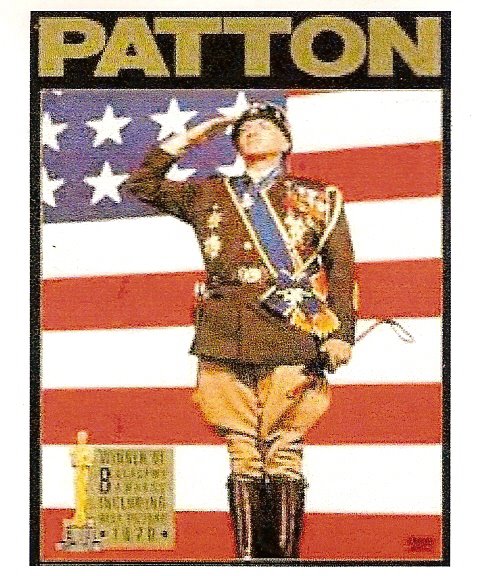
At a memorable moment in the movie Patton, George C. Scott as the General crows as his tactics foil the North Africa strategy of Rommel, the German "Desert Fox."
"Rommel, you magnificent bastard," he shouts, "I read your book!" For Rommel had published his innovations in the art of war, and Patton, a keen student of military history, possessed the ultimate advantage: he knew his opponents mind. Rommel was defeated before the engagement had begun.
Well, the marriage dissolved last year, and no, the two of us never did walk up and yell "I READ YOUR BOOK!!!, although I did read it, from cover to cover on numerous occasions, and use it as reference material even now.
Maybe The Sensei was trying to tell me something...............

Anyway, during multiple conversations with The Sensei after his giving me his autobiography, he eluded to the Patton, Rommel story.
Even if ones plans are not to take over the world, it is always good to study the strategy of those whose plans do entail domination.
The works of great strategists like Sun Tzu's Art of War, Miyamoto Musashi's Book of Five Rings, and on a darker side, Hitler's Mein Kampf, Mao's Little Red Book, and also Tojo and the coming of war by Robert J C Butow, are all insightful as to learning what to watch out for. Oh, and if you have never read The Turner Diaries http://www.skrewdriver.net/turnerintro.html then you have no insight as to what went down in Oklahoma, and what is bound to happen again here in the US. This book was written prior to the Oklahoma Bombing.
Maxims such as the ever popular "Divide and Conquer" are used and seen by all of us, in the dojo / martial arts politics, on the job, in relationships etc etc ad nausium.
Just as the practice of weapons in your martial arts training, is not just for tradition or the bi product of physical development which is gleaned from the handling of weapons = most of you are not going to use a nunchaku, katana, knife, sai, or spear in a fight on the street, knowledge of the use of these weapons capacitates the ability to better defend against an armed attacker.
Familiarity with the Motis Operandi of the enemy is capacitation for defense and or anialation.
This is why I watched, much more than I ever played, when it came to chess games with The Sensei at the dojo.
OneGaeShimasu Sensei!
Your teachings continue with new lessons every day.
Domo Arigato Gozai Mashita!
Thank You, For Being You.
Saturday, December 01, 2007
The new and complete symbol, and what it symbolizes.
 Osu!
Osu!At the encouragment of some of my black belts, I have reintroduced a symbol that we once used many years ago, in conjunction with the badge that has been in the process of development for the past while. As you scroll down, you will find a detailed explanation of the meanings behind the various facets of our logo. Please note that although I have strong religious beleifs, "Christian," I do not push my beleifs on my people. You will find that much that is contained in our logo, has been taken from Eastern spirituality. Although I do understand their meanings, most of them have a different meaning to me. The various facets are meant to be an historical and philisophical expression.
Nio
 The Nio (Benevolent Kings) are a pair of protectors who stand guard outside the temple gate at most Japanese Buddhist temples, one on either side of the entrance. In Japan, the gate itself is often called the Nio-mon (literally Nio Gate). Their fierce and threatening appearance wards off evil spirits and keeps the temple ground free of demons and thieves. In some accounts, the Nio were said to have followed and protected the historical Buddha when he traveled throughout India. They have since been adopted by the Japanese into the Japanese Buddhist pantheon. Each is named after a particular cosmic sound. The open-mouthed figure is called "Agyo," who is uttering the sound "ah," meaning birth. His closed-mouth partner is called "Ungyo," who sounds "un" or "om," meaning death. Other explanations for the open/closed mouth include: (1) mouth open to scare off demons, closed to shelter/keep in the good spirits; (2) "Ah" is the first letter in the Sanskrit alphabet and "Un" is the last (same in Japanese syllabary too), so the combination symbolically represents all possible outcomes (from alpha to omega) in the cosmic dance of existence. At some Buddhist temples, the Nio guardians are replaced with a pair of mythical and magical Shishi Lion-Dogs -- one with mouth open, the other closed.
These nio were the symbols of the Arakaki Naha Te Kempo DoJo that I trained in while living in Okinawa. I used the Nio as my DoJo's symbol when I returned to the U.S.
To me, the nio symbolize guardian angels, who protect us from the adversary, Satan, his demons, and ourselves, by reminding us of our true purpose, when we are not thinking or acting righteously.
Yata No Kagami
The outer edge of our symbol, which at first glance appears to be a flower, is actually Yata no kagami, which symbolizes wisdom or honesty,
Yata no Kagami, or "The Mirror Yata" or "The Octagonal Mirror". According to the mythical history of Japan, the Gods offered three sacred gifts to the first japanese emperor to prove his "divine descendence":
1. KUSANAGI NO TSURUGI - "The Sword Kusanagi"
2. YASAKANI NO MAGATAMA - "The Jewel Yasakani"
3. YATA NO KAGAMI - "The Mirror Yata"
 Of course Emporor Hirohito was forced to admit the falshood of this divinity to the masses of Japan by General McArthur, after the defeat of the Land Of The Rising Sun in WW2.
 The form is modeled after an ancient 8-sided copper mirror (called yata-no-kagami). This mirror is chronicled in Japanese Shinto legends and the shape is represented in numerous Japanese crests (mon). The mirror, reflecting everything truthfully, is a symbol for honesty.
The Yata no Kagami is not a normal mirror. Unlike normal mirrors that reflect our external image, Yata no Kagami reflects our soul. For this reason, there are always mirrors inside Shinto temples (it is said the original Yata no Kagame still remains untouched inside a Shinto temple in Japan).
 The shape = octagonal, is seen in the Chinese eight diagrams “ Pa Kwa,” and is popular replete with mirror in the Fanshuei that is used today in the decorating of so many homes and businesses.
To me, it symbolizes that if you want the honest truth, look in the mirror.
Yata no Kagami, or "The Mirror Yata" or "The Octagonal Mirror". According to the mythical history of Japan, the Gods offered three sacred gifts to the first japanese emperor to prove his "divine descendence":
1. KUSANAGI NO TSURUGI - "The Sword Kusanagi"
2. YASAKANI NO MAGATAMA - "The Jewel Yasakani"
3. YATA NO KAGAMI - "The Mirror Yata"
 Of course Emporor Hirohito was forced to admit the falshood of this divinity to the masses of Japan by General McArthur, after the defeat of the Land Of The Rising Sun in WW2.
 The form is modeled after an ancient 8-sided copper mirror (called yata-no-kagami). This mirror is chronicled in Japanese Shinto legends and the shape is represented in numerous Japanese crests (mon). The mirror, reflecting everything truthfully, is a symbol for honesty.
The Yata no Kagami is not a normal mirror. Unlike normal mirrors that reflect our external image, Yata no Kagami reflects our soul. For this reason, there are always mirrors inside Shinto temples (it is said the original Yata no Kagame still remains untouched inside a Shinto temple in Japan).
 The shape = octagonal, is seen in the Chinese eight diagrams “ Pa Kwa,” and is popular replete with mirror in the Fanshuei that is used today in the decorating of so many homes and businesses.
To me, it symbolizes that if you want the honest truth, look in the mirror.
Sakurabana
 The flower seen on our logo is called Sakurabana, The cherry blossom, which was considered an especially beautiful and important symbol for Japanese samurai because at the height of its beauty it would inevitably fall to the ground to die. Samurai also had to be willing to sacrifice themselves in their prime, and the cherry blossom was evidence that this is the natural way of things and could even be beautiful and pure. Life is as delicate and light as the falling petals, and there is a natural time for all beautiful things to end. The samurai strove to understand the nature of life and death by meditating on the blossom of the cherry tree. This peace was tempered by the inner strength, power, and fighting spirit represented by the circle of red. Through the study of attack and defense in GoJu Jitsu, we learn to harmonize our spirit and body, learning to both fight hard and let go softly.
In Eugen Herrigel's "Zen in the Art of Archery" (1953) it is said that "It is not for nothing that the Samurai have chosen for their truest symbol the fragile cherry blossom. Like a petal dropping in the morning sunlight and floating serenely to earth, so must the fearless detach himself from life, silent and inwardly unmoved."
The GoJu Jitsu Cross
 The name of our organization is written in the shape of a cross. From a Christian view, the cross is self explanatory. But being that this cross is in the same shape as the Iron Cross, as made popular these days by West Coast Choppers, and even though any one who knows me, knows that I am anything but racially prejudice, I feel that an explaination of it's meaning may be necessary.
 The origins of the Prussian/German "Iron Cross".
The tradition of the Iron Cross (which was Cross Pattée in shape) had an honourable beginning, when it was instituted as a Prussian decoration, in March 1813, by King Friedrich Wilheim III during the War of Liberation against Napoleon. It was awarded without regard for nationality or social class to combatants for acts of heroism, bravery or leadership skills.
Tetsu Te
Tetsu Te is Nihon Go = Japanese language meaning Iron Hands, which is the moniquor given to me by Maestro Peter Urban. His rationale for this was my hand conditioning and the way that I lead my troops.
Shobu
Shobu is Nihon Go = Japanese language literally translated as mortal combat. I avoid using this translation, as it appears to con notate the martial fiction movie of the same name. Of course this word was around eons before movies even existed.
Nowadays, Shobu often refers to a contest. The Ju Jitsu that is encompassed in our style is not for sport, but a contest in which the prize is going home alive.
Nowadays, Shobu often refers to a contest. The Ju Jitsu that is encompassed in our style is not for sport, but a contest in which the prize is going home alive.


Truth / Actual
 When the martial arts were first introduced to the west, the accepted spelling of the kanji for soft or gentle was Jitsu. Later scholors realized that the phonetic spelling translated a different word all together. The kanji that is pronounced Jitsu actually means Truth or Actual, which I also find appropriate. Ergo, we use the original Romanization which can be translated either way.

The clenched fist.
 The clenched fist is the likeness of the fist of Miyagi Chojun, Sensei,
 the founder of GoJu Ryu.
It was first used by Yamaguchi Gogen, Sensei,as the symbol of his KaraTe club at Ritzumeikan University in Japan. It later became the symbol of the Nippon GoJu Kai, and was adopted by his student Peter Urban, Sensei, as the symbol of USA GoJu. Urban changed the kanji writing on the wrist and ribbon of the original, to the English writing of USA GoJu. We have eliminated all of the writing on the wrist and ribbon, and changed the color to red.
Futatsu tomoe
 This symbol is ubiquitous on Buddhist and Shinto temples all over Japan. Its name is tomoe, meaning turning or circular, referring to the motion of the earth. The tomoe is related to the yin yang symbol, and has a similar meaning, representing the play of forces in the cosmos. Visually, the tomoe is made up of interlocked flames resembling tadpoles.
 The Futatsu Tomoe has been used by various Warrior families, sects and clans throughout the history of China and Japan. As a matter of fact, it is the family crest of one of my MeiBuKan GoJu Ryu Sensei’s “ Ikemiyagi “ who I spent time with while I was living in Okinawa. Ikemiyagi’s family originally came from China.
During a recent epiphany of mine, I realized that our use of it is symbolic of the cycle of perpetuation of both the positive and negative teachings that we experienced from our own teachers and parents, and thereby pass on later to our students and children. This reminder of such perpetuation serves as a tool as for us to attempt to be cognizant of what we carry with us as negative vs. positive, understanding that a balance of the two is extant, but not necessary to pass on.
Of course the duality of this symbol represents the Hard and soft = Go Ju
 It can also be seen in concept used in various technique, such as this one being executed by yours truly, called Tomoe Nage.
The meaningfulness of the colors:
RED stimulates brain wave activity, increases heart rate, respirations and blood pressure, excites sexual glands. It energizes the first chakra (coccyx). It warms us and awakens us physically and energizes our blood. It is a good color to wear when we have colds and poor circulation. Too much red can over stimulate and make some illnesses worse. High blood pressure is an indicator of too much red energy in the body. It is a color for war, prosperity, fire, and rising sun. Spiritually it is the root color of fire and connects us to our physical self.
Black: self-confidence, power, strength
Black: self-confidence, power, strength
Subscribe to:
Posts (Atom)


